

Every era of software engineering has had its scarce resource. For a long time, knowledge itself was expensive to acquire. Understanding a new technology could take days of reading documentation, books, and source code. AI has dramatically reduced that cost: today, almost any concept can be explained within seconds.
But scarcity never disappears. It moves.
Recently, I spoke with several experienced engineers about what becomes more valuable when knowledge itself is easier to access. One question stood out in our discussions: Should we learn deeply or broadly in the age of AI?
We generally agreed that breadth of knowledge is becoming increasingly valuable. But this does not mean that deep expertise is no longer important.
In fact, breadth and depth reinforce each other, and developing one can naturally contribute to the other.
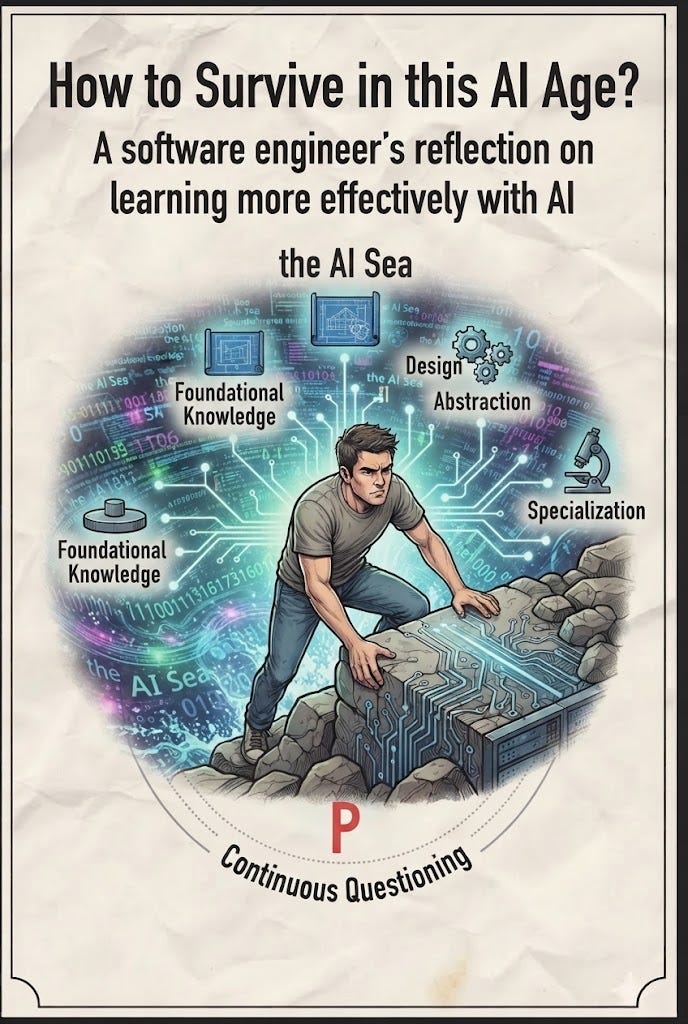
Why does breadth matter more in the age of AI?
With the rise of agentic AI, a simple prompt can trigger a complex workflow or generate a comprehensive report. However, tasks such as system design, debugging, and product exploration rarely end with a single prompt. They usually require an extended conversation in which you continuously ask questions, evaluate the responses, and decide which direction to explore next.
This changes the value of knowledge. You may not need deep expertise in every topic, but you need enough familiarity to recognize important concepts when they appear. Once you identify a relevant concept in an AI response, you can formulate a follow-up question and guide the AI toward a potentially useful direction.
In other words, broad knowledge expands the range of questions you are capable of asking. AI may help you find the answers, but you still need enough knowledge to know which questions are worth asking.
From my perspective, however, developing breadth is actually more challenging than developing depth. When studying a specific topic in depth, you usually have a relatively clear direction and learning path. Building breadth is different: it requires you to discover and explore fields that you may not even know exist.
So how can we discover these unknown fields? One possible answer is to start by going deeper into what we already know.
Go Deeper: Ask Why and Explore Alternatives
This brings us back to the relationship between depth and breadth. Diving deeply into one topic naturally exposes you to a range of related concepts. Rather than simply learning what each concept does, however, I believe it is more important to ask three questions: What problem is it trying to solve? What assumptions does the solution make? And what trade-offs does it introduce?
From there, you can investigate alternative solutions and compare how they approach the same problem. Each alternative may introduce unfamiliar concepts or technologies because different solutions are built around different assumptions and make different trade-offs.
This creates a natural path from depth to breadth: you begin with one problem, understand one solution deeply, explore its alternatives, and gradually discover adjacent fields along the way.
Therefore, paradoxically, one of the most effective ways to broaden your knowledge is to start by learning something deeply.
The next challenge, then, is how to learn deeply and effectively—and this is where AI can help.
Build Your Reasoning Through Questions, Not Answers
Although developing depth can naturally expand the breadth of our knowledge, how we learn deeply matters. Rather than memorizing isolated concepts, I believe we should focus on constructing our own reasoning about a subject. AI makes this process considerably easier.
Everyone approaches learning with different experiences, prior knowledge, and mental models. As a result, two people may follow entirely different lines of reasoning and still arrive at the same conclusion. What matters is not merely remembering the conclusion, but understanding the chain of questions that leads you there.
This is where AI becomes particularly valuable. Reasoning can be viewed as an iterative process of asking questions, examining answers, and generating better follow-up questions. With AI, you can continue this process without worrying that a question is too basic or that you are taking up someone else’s time.
Repeatedly questioning, digesting, and refining your understanding helps develop two important abilities: abstraction and mental-model building.
Mental models help you understand unfamiliar concepts more quickly by providing a reusable framework for reasoning, while abstraction allows you to transfer ideas from one domain to another.
One of My Mental Models for Understanding New Concepts
One mental model I find particularly useful is to start with the simplest, most naive solution whenever I struggle to understand why a technology was designed in a particular way.
Take MVCC as an example. It is widely used in database systems to support transaction isolation. Instead of simply memorizing how MVCC works, I start with a more fundamental question: without MVCC, how could we prevent one transaction from reading another transaction’s uncommitted changes?
The first step is to seek alternatives. I usually start with the simplest possible solution because it is often the easiest one to come up with on my own, without relying on prior knowledge of the actual design.
For MVCC, the most straightforward alternative is to use locks. This immediately leads to the next step: examining the trade-offs. What happens when concurrency increases? Lock contention can become a major bottleneck.
Following this reasoning helps explain why maintaining multiple versions of data is useful. Rather than forcing readers and writers to compete for access to the same version of a record, MVCC allows them to operate on different versions under appropriate visibility rules.
The final step is to build an abstraction. The idea is no longer limited to MVCC: maintaining different versions or copies of data can reduce coordination and contention between concurrent readers and writers. Once we extract this underlying pattern, we can recognize similar ideas in other domains, such as Read-Copy-Update (RCU) concurrency control in the Linux kernel.
This gives me a reusable reasoning process: seek alternatives → examine trade-offs → build an abstraction. AI can accelerate this process by helping me explore each question and alternative, rather than simply giving me the final answer.
But when it comes to building breadth, this raises another question: how much do we actually need to understand before moving on, and when should we go deeper?
Building Layers into Your Mental Model
Once you have developed a mental model for learning unfamiliar concepts, the next step is to give that model different levels of depth. This allows you to build broad knowledge efficiently without feeling the need to master every field you encounter.
I organize my learning into three layers:
Layer 1 — Purpose and intuition: What is it? What problem does it solve? Why does that problem matter?
Layer 2 — Design and trade-offs: How does the technology solve the problem? What assumptions does it make? What trade-offs does it introduce? What alternatives exist? What does the high-level architecture look like?
Layer 3 — Implementation and internals: How is it actually implemented? How do you debug it? How do you analyze its behavior and internal details?
Consider learning how an AI model is trained. I might begin with fundamental questions: What is machine learning? How does a machine learn from data? Why are linear algebra and calculus important?
I can then move toward questions about the solution itself. What would the simplest approach to adjusting a model be? In next-token prediction, what exactly are we trying to optimize? Why do we need more sophisticated architectures?
From there, I might explore architectural questions: How does a Transformer handle long-range dependencies? How does it differ from CNNs and RNNs, and what limitations of earlier approaches was it designed to address?
Answering questions at this level gives me a working mental model of the field without requiring deep expertise in every implementation detail. For many adjacent fields, reaching Layer 1 or Layer 2 may already be sufficient.
If a field later becomes important to my work, I can continue into Layer 3. With a clear understanding of the underlying problem, design choices, and trade-offs, I can develop a deeper learning roadmap much faster and, more importantly, know which questions are worth asking as I explore the implementation details.
In this way, breadth doesn’t come at the expense of depth; instead, it provides a foundation that makes deeper learning faster and more focused.
But as AI continues to reduce the cost of learning, a new bottleneck emerges.
If knowledge is no longer the scarce resource, what is?
Managing Attention and Anxiety in the Age of AI
AI has dramatically lowered the barrier to accessing information and learning new skills. At the same time, however, information overload has become a more serious problem. There is always another concept to learn, another AI response to read, and another direction to explore. This endless stream of information can easily leave us mentally exhausted and anxious. Without the ability to manage our attention and emotions, we may lose ourselves in it—or simply accept AI-generated answers without questioning them critically.
This is why effective learning is not just about having the right methodology. In the age of AI, managing our attention and anxiety has become equally important.
As knowledge becomes increasingly accessible, attention is becoming one of the scarcest resources in learning.
For me, emotional management begins with awareness. Our emotions influence how we behave and make decisions. Procrastination, for example, is not always caused by a lack of energy or discipline. Sometimes, it comes from emotional resistance to a task, such as anxiety or discomfort. Recognizing what we are feeling and what triggers that feeling is therefore an important first step.
Understanding what a calm emotional baseline feels like can also improve emotional awareness.
Personally, I periodically practice what is often called a “dopamine detox,” such as reducing my phone usage for a period of time. At first, this can be difficult, and I may experience strong urges or discomfort. But once I get through the initial period, I become more aware of what a genuinely calm emotional state feels like and how much it helps me stay focused.
The value of a dopamine detox, in my experience, is that we can become so accustomed to constant stimulation—from social media, short-form videos, low-quality AI-generated content, streaming platforms, and other forms of digital entertainment—that a highly stimulated state starts to feel normal. Over time, this can make sustained concentration more difficult and leave us feeling mentally drained or emotionally low without clearly understanding why.
However, this doesn’t mean that we need to eliminate entertainment entirely. Once a dopamine detox helps me establish a calmer baseline, the key is to become more conscious of how much digital stimulation I consume and to recognize changes in my mood and attention.
When I notice that I’ve consumed too much low-quality content or become distracted by excessive digital stimulation, I can catch the pattern before getting pulled too deeply into it. I can then step away for a while, reduce the stimulation again, and gradually regain that sense of calm and focus.
Conclusion
At the beginning, I said that scarcity never disappears—it moves. I initially thought the challenge in the age of AI was simply finding a better way to learn: balancing breadth and depth, asking better questions, and building stronger mental models.
But AI has made learning easier than ever. The real scarce resource is becoming our attention and our ability to manage it. Ultimately, learning effectively with AI is not just about knowing how to learn, but also about staying focused, managing our emotions, and thinking critically in a world of unlimited information.