

This year I was lucky enough to get a Google SWE (Software Engineer) offer. While preparing, I got a lot of help from the community, both from other people’s write-ups and from conversations with Googlers. So I decided to write about my own process, in the hope that it helps someone else.
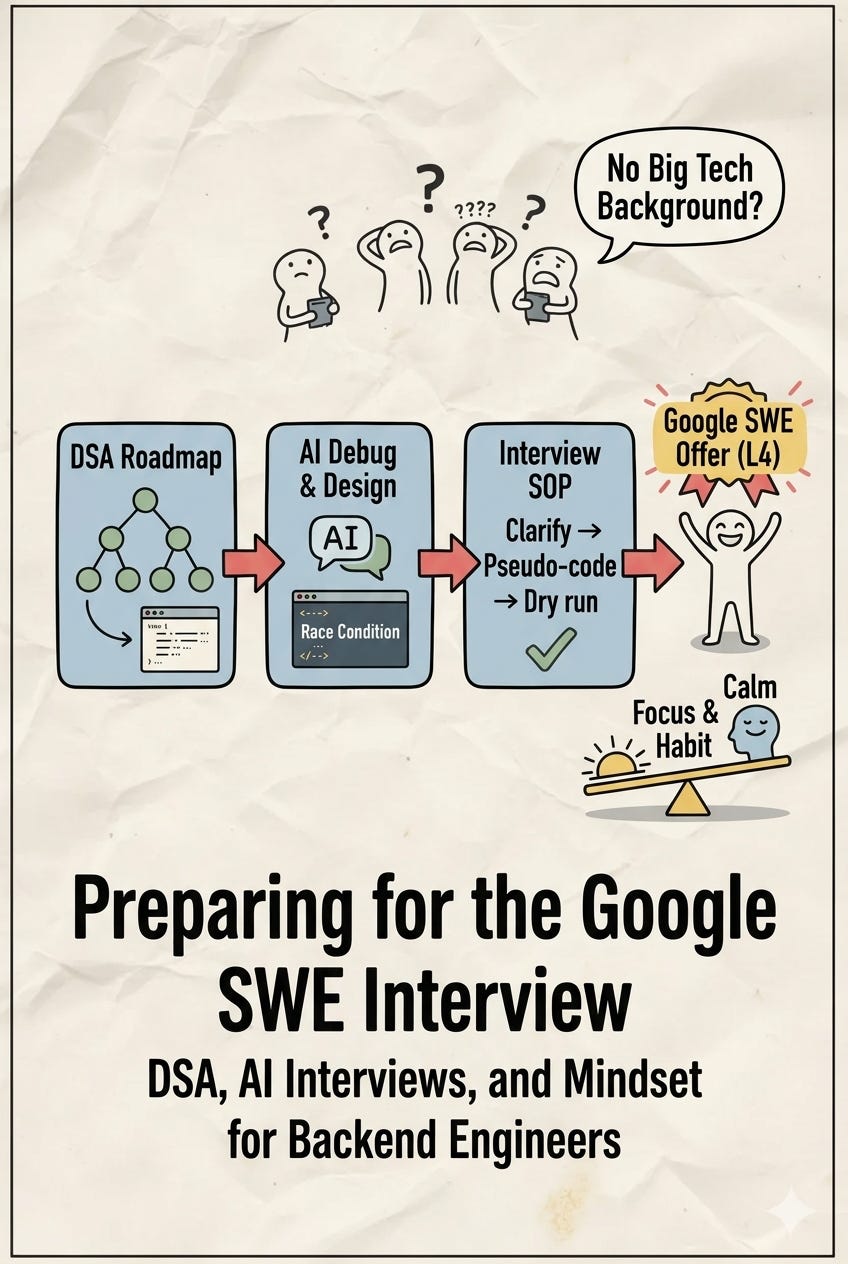
My background
I worked as a backend engineer in Taiwan for 5 years, all at small and mid-sized companies, and I studied information management in college. I started preparing for interviews in my early 30s and got a Google L4 SWE offer at 31.
If you have also been working for a while, believe me, you still have a chance!
Now let me walk through how I prepared, starting with LeetCode.
How I prepared for LeetCode DSA
I spent more than a year preparing DSA (Data Structures and Algorithms). Since I still had a full-time job, I practiced in the mornings and forced myself to get up early. I split this period into three stages.
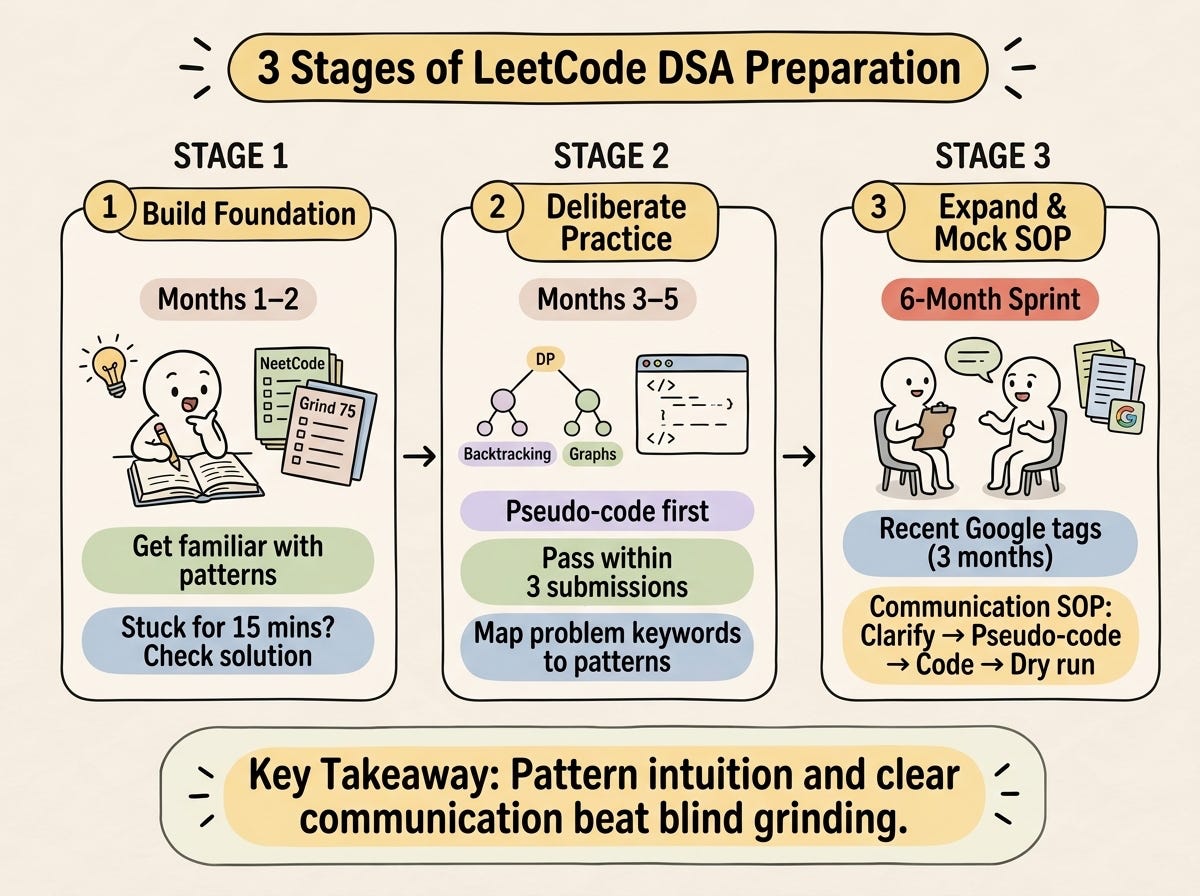
Stage 1: Build the foundation.
Work through the well-known problem lists once, such as NeetCode and Grind 75 or Grind 150.
The goal of this stage is to get familiar with the common problem patterns. If you can’t solve a problem in 15 minutes, don’t hesitate: look at the solution.
Stage 2: Practice deliberately and build intuition for problems and patterns.
Go through NeetCode a second time. This time, don’t look at the solutions, and pay attention to code quality. Get used to writing pseudo code before the implementation, and try to pass all the test cases within 3 submissions.
On top of that, build your own problem categories, and make them as fine-grained as possible. For example, DP (Dynamic Programming) can be further split into sequential DP, bitmask DP, knapsack DP, palindrome DP, and so on.
Once you have categories, practice recognizing which pattern a problem needs from its keywords. A simple example: if you need to enumerate every possibility, it is usually backtracking; but if you need to count how many combinations of a certain kind exist, it is usually DP.
Stage 3: Expand your coverage and practice interviewing.
The well-known lists cover roughly 60% of problem types, so you still need to prepare for the rest. I highly recommend the Google-tagged questions on LeetCode, which help you explore more problem types. Pick the ones from the last three months and focus on mediums. At the same time, find a good friend to do mock interviews with.
Google’s algorithm interviews care a lot about communication, so use your mock interviews to build your own SOP:
- First clarify the problem: define the input, output and constraints, then use one or two test cases to confirm the edge cases
- Explain your approach in pseudo code, explain the complexity, and check with the interviewer that the logic is right
- Only then start writing code
- Review after writing: dry run one test case to confirm the logic, then check for syntax errors and for conditions you haven’t covered, such as a missing if branch
I finished stages 1 and 2 in about 4 to 5 months, and spent the remaining 6 months pushing through stage 3.
Besides DSA, you also need to prepare for BQ and AI interviews. Google has started running AI interviews too (ref: https://lnkd.in/p/g5HTjiVZ).
How I prepared for BQ and AI interviews
For BQ (Behavioral Questions), I first grouped the questions into categories, such as teamwork, project management, and project experience (for example, the hardest project you have worked on, or a technical problem outside your comfort zone).
The mainstream answer structure is STAR (Situation, Task, Action, Result). But from what I observed, the key is to show how you make decisions.
Keep S and T simple and easy to follow.
For A, the key is to describe your decision-making process well. Decisions can’t rest on gut feeling. Explain how you broke the problem down, how you defined hypotheses and verified them, and what backed you up: data, or guidance from someone with authority (e.g. consulting a staff engineer). You don’t need to make it complicated; what matters is that the reasoning has a clear thread.
R should be positive. Don’t exaggerate, but do present it well. Besides how much performance improved or how much business impact it brought, you can also talk about the impact on your team, such as which workflow you improved. I’ve found that people who actively look for pain points in how the team works, and fix them on their own initiative, are highly valued in the current AI era.
Next is the AI interview. Google didn’t have AI interviews yet when I interviewed, but I ran into them at other companies, so I’ll share the questions I got.
The first kind is AI debug: you’re given a piece of code and asked what’s wrong with it. The interviewer wants you to come up with the general direction first and then ask the AI to verify it, and they watch how you discuss the problem with the AI. Once you have a fix, they’ll ask you to explain it and walk through the trade-offs.
At the time, many AI debug questions were about race conditions. Here is one I liked:
transaction: begin → update xxx → send_email → commit.
What’s the problem?
The transaction can get stuck on send_email, so the row lock taken by the update is held for too long.
How would you fix it? Move send_email out of the transaction and run it asynchronously on a thread.
At this point the interviewer asks: what happens if a large burst of requests comes in at once? This is where the thread pool comes in.
Then they push further: is there something more resource-efficient than a thread pool? The answer is the reactor pattern (epoll), which uses a small number of threads to handle a large amount of I/O.
Going one level deeper, you can also discuss how to keep the state written by the update consistent with the behavior of the external email system.
The second kind is AI system design. I once saw someone share on Medium that they were asked to design a file system with AI. You aren’t expected to write a real kernel file system. Instead, you analyze the functional and non-functional requirements, then write the logic of a file system module. You never touch a real disk; every operation is simulated with in-memory data. What matters is how you define the requirements and whether you pick the right data structures and algorithms.
Personally, I think adding AI interviews is a good thing. Algorithm-grinding skills are hard to scale to interviews at other companies, while the skills AI interviews test can be trained in your day-to-day work, and the preparation carries over to other companies. More and more companies are starting to run AI interviews, and the weight of algorithms is going down.
Once you’re prepared, the next step is getting an interview.
How to get a Google interview
First, prepare your resume. There are three things to watch out for.
First, don’t use language-based titles like Java developer or Go developer; just write software engineer. Google uses all kinds of languages internally and puts a lot of weight on the mindset of picking up new tools. And now that so much code is written with AI, the language itself is no longer a barrier.
Second, you must get someone with big tech experience to review your resume. Only they know what big tech managers look for, and they can help you find your blind spots. It’s best to tell the reviewer which position you want to apply for and include the JD (Job Description) link.
Third, tailor your resume to the JD you want most. The hiring manager is a key gate for whether you get an interview, and if your resume doesn’t catch their attention, that’s the end of it.
Next, you must get a referral. A referral means your resume will definitely be seen by HR, and your chances of being contacted go up a lot. You can message Googlers on LinkedIn, or find Googlers on a mentoring platform (such as 大大帶我飛, a Taiwanese mentorship site).
After the referral you’ll receive a link, and you can choose 3 positions to apply for. Remember to tailor your resume to one of them.
Preparing once the interview process starts
When HR contacts you and says you can start scheduling interviews, they usually ask how much more time you need to prepare. I said 1 month, but this can affect the rest of the process, because the position you want might be taken by someone else in the meantime. Also, before the real interviews, you can ask HR for a mock interview with a Googler; the result doesn’t affect your actual interviews.
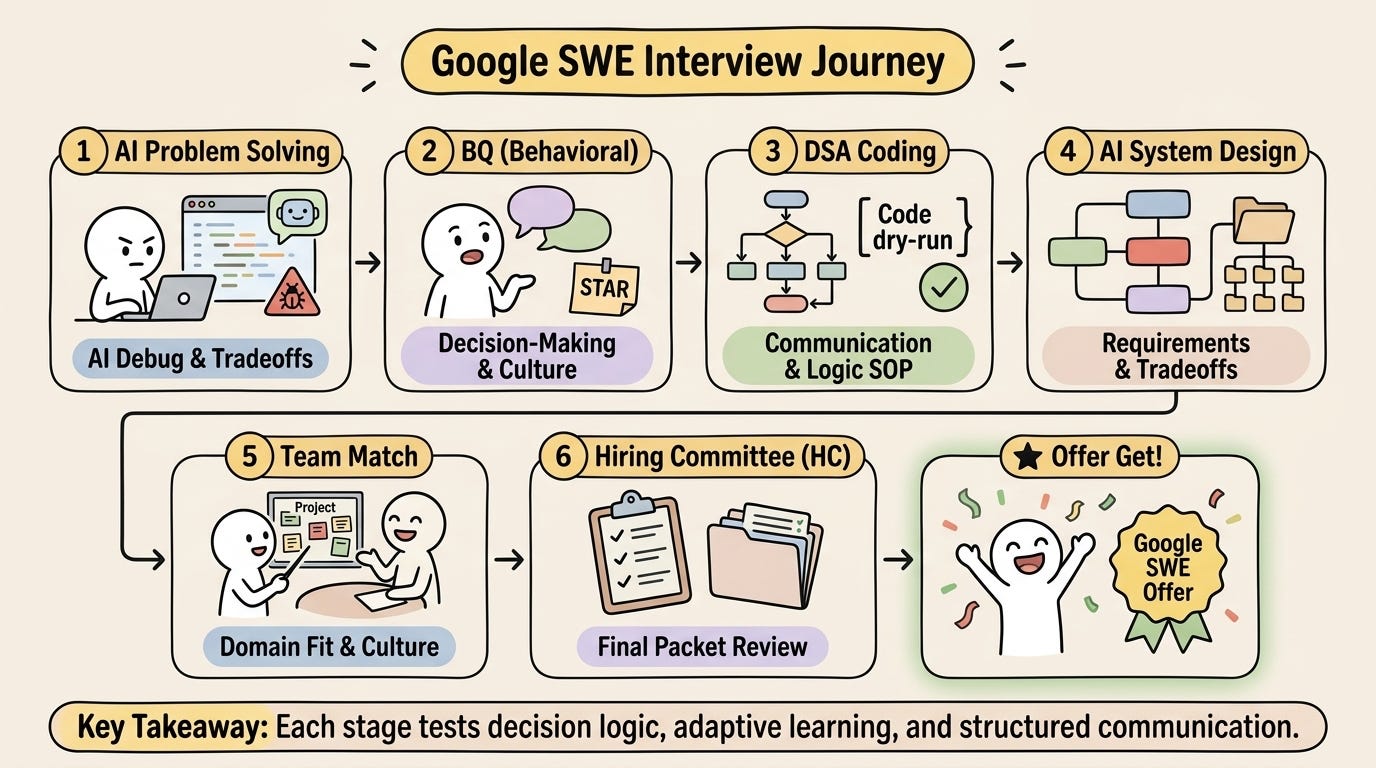
Then come 4 interview rounds: 3 technical and 1 behavioral.
If you pass all 4, you move on to team match, and finally the HC (Hiring Committee).
The timing of team match is hard to control. During this period I strongly recommend writing a side project targeted at the position. The side project isn’t meant to solve a real problem; it’s meant to show the hiring manager that you can learn their domain and technology. So write the README clearly. Don’t just let AI generate it; make sure you understand the details.
Team match can drag on for a long time, and after you’re matched and sent to HC, you may be asked to do an additional interview. So make sure you keep practicing problems during team match.
Mental preparation also matters. Once the interviews start, the pressure is intense, and it’s easy to blow every mistake you made out of proportion.
But first, understand that excessive stress doesn’t help you at all. It comes from replaying past mistakes over and over, or worrying about the outcome. So staying focused on the present is important: if you still have a job, do your job well, eat well, exercise, practice your problems, and don’t think about anything else.
Making a mistake in an interview, such as getting a piece of code wrong, won’t be the reason you fail. In one of my rounds I made a mistake: the overall logic was right, but I missed a corner case. Even so, the interviewer said I thought quickly and communicated clearly, and still gave me positive feedback.
Also, don’t panic when you get a hard problem. Write the brute-force solution first, then propose optimizations. Remember to tell the interviewer up front that you’d like to start with brute force. That way you at least get the base score, and if your communication is good, you can earn extra points on top of it.
Beyond all of this preparation, I kept wondering at the time: without relevant technical experience, is preparing DSA, BQ and AI interviews enough?
What if you don’t have relevant technical experience?
At Google Taiwan, most of the work is hardware-related, such as rack management for Cloud or Android OS driver integration for Pixel.
If your background is like mine, all web or mobile application-level development, you’ll surely wonder what to do without relevant experience.
My personal take is that if you’re aiming for Google L3 or L4, you don’t need to worry too much; you can still prepare for it. For example:
- L3: in team match, culture matters more than technology. Culture here doesn’t mean personality. It means how you think when facing a problem, how you see AI-assisted development, and how quickly you adapt to different technologies and work environments. It’s a bit like BQ, but with more focus on how you respond and reason.
- L4: in team match, both culture and technology are evaluated, though it depends a lot on the manager. When I went through L4 team match, I was asked about both. The technical questions weren’t deep domain knowledge; they were more like general kernel-related concepts.
So, besides DSA, BQ and AI, what else should you prepare to improve your chances in team match?
For L3, I highly recommend C++. C++ is the mainstream language inside Google, especially in Taiwan, and Rust is gradually appearing too. If you used C++ for your AI interviews and DSA, it shows you’re comfortable with C++, so at the very least you’ll have no trouble reading code once you join.
Preparing C++ isn’t about memorizing syntax either. The key is general knowledge such as RAII (Resource Acquisition Is Initialization), ownership (unique_ptr, move semantics), multithreading, templates (generics), and compiler optimizations.
For L4, I recommend getting familiar with some kernel technology. You don’t need to learn OS from scratch; you can start by understanding how some system calls work. For example, as a backend engineer, networking (epoll, netfilter/iptables), containers (namespaces for isolation, cgroups for resource limits) and memory management (e.g. mmap, sendfile) are all well worth learning.
Preparing for interviews is a hard process. There’s always something new to learn, and it can make you anxious, so your physical and mental health matter a lot.
Health matters more than you think
During my year-plus of preparation, the world changed fast, and it will keep doing so. All kinds of information can make you anxious.
But tell yourself: focus on yourself and believe in your goal. That matters most. Don’t let the outside world affect you too much.
During this period I also realized that being aware of my own emotions is important, because attention is closely tied to emotion.
When I started preparing, I had limited practice time each day, so I needed to get the most out of it, and focus was the key.
Just as the root cause of procrastination is the emotion of wanting to avoid a task, focus is also affected by emotion, especially anxiety.
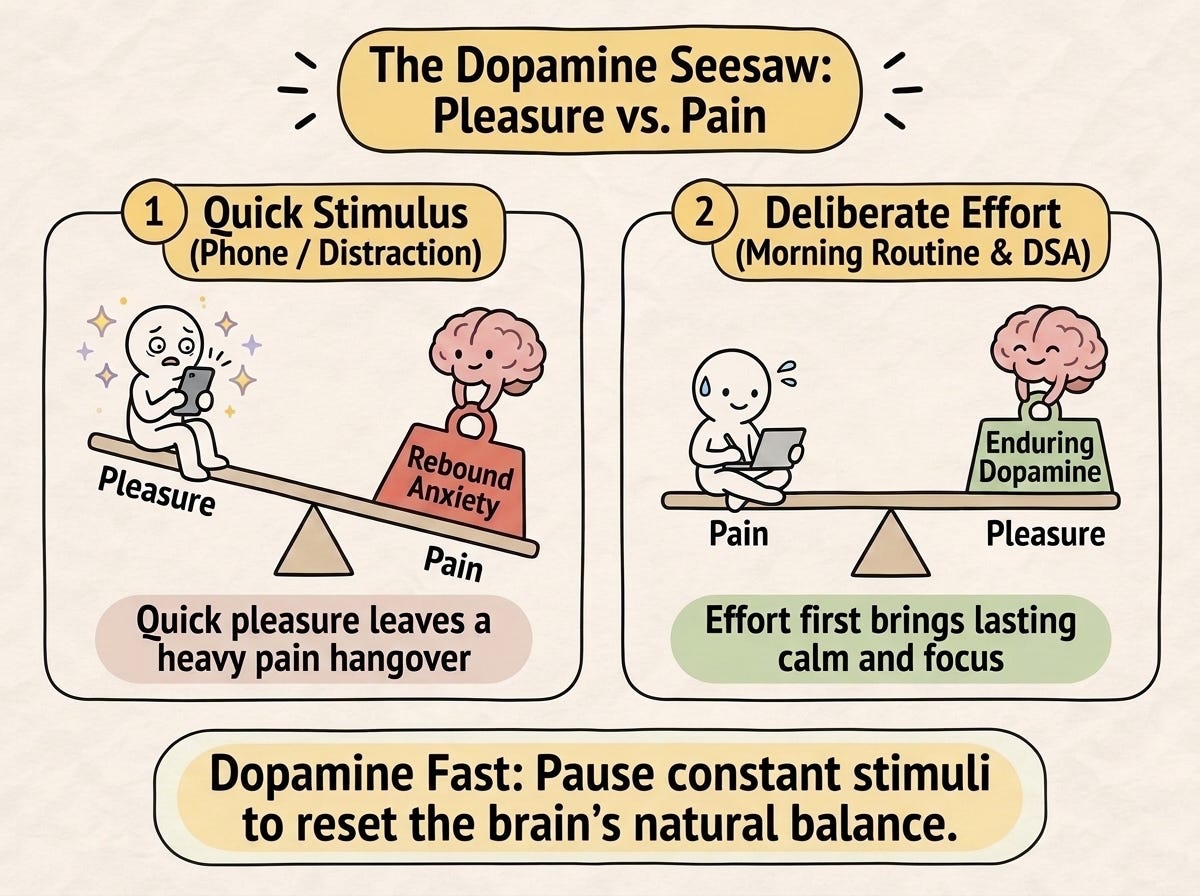
One source of anxiety is an imbalanced dopamine system. In Dopamine Nation, Anna Lembke uses a seesaw as a metaphor: pleasure and pain sit at the two ends of a seesaw, and the brain tries to keep it level.
Every time you enjoy something pleasurable, the seesaw tilts toward pleasure, and the brain adds weight to the pain side to push it back, and it overshoots. That’s why, after the high, there’s often a stretch where you feel worse than before, like the emptiness after scrolling short videos.
But if you reach for a new stimulus as soon as you feel uncomfortable, the pain doesn’t get canceled out by pleasure. Instead, the seesaw tips further toward pain. Each new stimulus makes the brain add a bit more weight to the pain side, while the same shows and the same videos give you less and less pleasure, not enough to offset that weight. The only way to offset it is to find something more stimulating, but you can’t always find it; and even when you do, the pain side gets heavier still.
In the end, the unbalanced seesaw leaves you anxious, irritable and restless, and your attention gets fragmented.
So how do you bring it back to level?
The answer is to stop the stimulation. The weight on the pain side is essentially an adjustment the brain makes to cope with constant stimulation. Once the stimulation stops, the brain has no reason to keep that adjustment and gradually removes it, and the seesaw comes back into balance. But removing it takes time, so the first few days actually feel worse; it only gets better once you push through.
This is what’s called a dopamine fast.
My approach: no phone from waking up until 9:30 in the morning, or after 8:30 in the evening. I also try not to use it over lunch, and on weekends when I go out, I try not to use it at all.
This was also how I built my early-rising habit. I found the effect very noticeable: my mood became much more stable, I was less tempted to stay in bed in the morning, I no longer felt dread at the thought of going to work, and I could stay focused for longer.
Besides that, a dopamine fast isn’t only about giving yourself less pleasure. You can also go the other way and give yourself a bit of pain first, such as exercising in the morning or taking a cold shower. After the pain, the brain still wants to restore balance, but this time it adds weight to the pleasure side, so what’s left is a longer-lasting good mood.
This is the exact opposite of scrolling your phone: pleasure first leaves you low afterward; pain first leaves you better afterward. Preparing for interviews works the same way. Getting up early to practice problems is painful, but the sense of achievement you earn through effort doesn’t leave you chasing more and feeling emptier.
That said, this doesn’t mean everyone should give up their devices and become a monk. The key is to know what the “normal level” feels like, so you know that your emotions and unease are something you can control, not something the outside world dictates. When you feel out of balance, find your own way to bring yourself back.
Finally, I hope this post helps anyone who is preparing right now. Good luck with your work and your interviews.